What it took to win in 2025 and what comes next
Some years are about momentum. Others are about muscle.
By Shaun Daniels, REPRO Rising VA Director of Campaigns and Programs
Some years are about momentum. Others are about muscle.
2025 was a year that asked more of everyone working to protect reproductive freedom in Virginia. The stakes were high, the calendar was unforgiving, and the path forward required both urgency and patience to win what was directly in front of us while preparing for what was still ahead.
At REPRO Rising Virginia, we entered this cycle clear-eyed about what the moment demanded. Not just wins on Election Day, but the kind of durable progress that can withstand disinformation, shifting political terrain, and the long road toward a constitutional amendment.
What follows is a look back at what we built, what we learned, and why we’re entering the next chapter more confident than ever.
Starting with Purpose
From the beginning, our work this year was anchored in two guiding outcomes.
First, protecting the path forward: ensuring the House of Delegates remained positioned to advance the reproductive freedom amendment when the General Assembly convenes.
Second, building what lasts: strengthening the infrastructure required for a statewide campaign if that amendment goes to voters in 2026.
Those goals shaped every decision where we showed up, how we invested, and what kind of program we chose to run. We weren’t trying to be everywhere. We were trying to be effective where it mattered most.
That meant making disciplined choices about districts, committing early to long-term capacity, and staying focused even when the news cycle pulled attention in every direction.
Choosing Depth Over Noise
In a year with dozens of competitive races and no shortage of urgency, restraint can be a strategy.
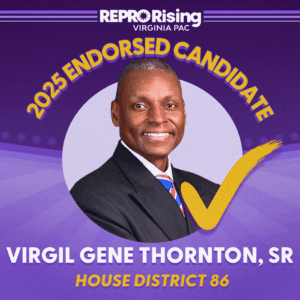
We focused our deepest engagement on a small number of pivotal House districts places where reproductive freedom, turnout dynamics, and future amendment math intersected in meaningful ways. Districts HD22, HD41, HD75, and HD86 weren’t just competitive; they were consequential.


In these places, our goal wasn’t visibility for its own sake. It was impact.
That looked like a mix of field work, digital outreach, volunteer recruitment, and relationship-building with campaigns and local leaders. Sometimes that work was loud and public. Other times it was quiet and steady conversations, training, and preparation that don’t always make headlines but change outcomes over time.
A Year Defined by Conversations
One of the defining features of our 2025 program was the scale and seriousness of our field work.
Across priority districts, REPRO Rising volunteers and organizers knocked thousands of doors, sent hundreds of thousands of texts, made calls, and most importantly had real conversations with voters. Not just quick transactional exchanges, but moments where people paused, reflected, and shared what these issues mean in their own lives.
This work wasn’t accidental. It grew out of our investment in deep canvassing a method grounded in empathy, listening, and values-based dialogue.
Deep canvassing doesn’t chase instant agreement. It creates space for people to wrestle with complexity, memory, and lived experience. In a political environment often driven by soundbites, that kind of engagement is both rare and powerful.
I spoke to a woman back in September who had changed her stance on abortion from pro-choice to pro-life as she found religion mattering more to her later in life. She did believe in exceptions in the case of rape and incest however and as we continued speaking she added more and more reasons, she found an abortion to potentially be necessary. She didn’t know that Virginia was the only one of its neighbors to have the access to reproductive healthcare that it does and was very concerned thinking about people who come here no longer being able to receive care. She eventually concluded that while she personally doesn’t like abortion, she didn’t want the government to ban it or to put unnecessary restrictions on people seeking them because she understands that they have various circumstances that lead them to that decision. It was a great conversation, and she was happy to hear that she may be able to vote directly on the constitutional amendment next year. – Trey McDonald, Blacksburg Canvass Organizer
Over and over, these conversations reinforced something important: voters across Virginia including many who don’t see themselves as activists care deeply about bodily autonomy, dignity, and fairness. They want information they can trust. And they respond when they feel respected rather than talked at.
Digital as a Complement, not a Crutch
Alongside field work, digital played a critical role in our 2025 strategy.
We approached digital not as a substitute for organizing, but as a tool to reinforce it filling information gaps, reaching voters who might not answer the door, and ensuring accurate messaging was visible in high-noise environments.
In one highly competitive district, our digital work became especially instructive.
What we learned early and then heard repeatedly was that the incumbent in HD75 had developed a broad reputation for political strength and bipartisan appeal. Among both political insiders and many voters, there was a sense that she was widely trusted and difficult to challenge.
On the ground, however, organizers and volunteers were hearing something more complicated.
They encountered voters, including people generally supportive of reproductive freedom who were surprised to learn that the incumbent’s public messaging did not always align with her legislative record. There was a gap between how she presented herself and how she had voted on key issues.
Rather than narrowing our message to people already firmly on our side, we made a deliberate choice to broaden it.
We ran digital ads aimed not only at voters likely to support reproductive freedom, but also at African American voters and conservative audiences, one of whom were being told a story about moderation and independence, the other of party loyalty. Our goal wasn’t to persuade everyone to agree with us; it was to establish a shared baseline of facts.
We cited votes. We grounded our arguments in the public record. And creatively, we used simple, accessible imagery things like weathervanes and wardrobe changes to communicate a lack of consistency and conviction, without relying on inflammatory language.
Most importantly, we trusted the people closest to voters.
This strategy grew directly out of what the Dougherty campaign, the coordinated campaign, and our own organizers and volunteers were hearing every day. We took those observations seriously and turned them into a plan to counter false impressions with clarity and credibility.
Back in September while I was deep canvassing, I met a older man in about his 70’s who had never formally met an adoptee before. He told me about how he believed it to be this beautiful, meaningful way to bring a child into a home. I informed him about the sad reality of the foster care system as well as my own story dealing with abusive adoptive parents. I explained to him how many people think that adoption is an “easy” way out of giving accessible and safe abortions, although the reality actually isn’t so sweet. He was shocked and said, “Thank you for sharing your story, I’m going to think about this when abortion and adoption are mentioned now. Thank you.” I left feeling hopeful and optimistic that although I never faced “justice,” like many adopted and foster kids do not, I left that door feeling my justice was being able to share my story about strength and how strength brings closeness. This man left understanding abortion and adoption a bit more. – Johanna Pasquel, Richmond Canvass Organizer
The result wasn’t just impressions or clicks. It was persuasive programming voters encountering consistent, values-driven information across platforms. And in a race, many initially viewed as a long shot, that clarity helped deliver a decisive victory for a reproductive freedom champion.
Digital works best when it’s grounded in real human insight. Our field conversations informed our messaging, and our messaging reinforced what organizers were hearing on the ground. That feedback loop will be even more important as we scale toward 2026.
The Human Side of Infrastructure
Infrastructure can sound abstract. In practice, it’s deeply personal.
It’s the volunteer who shows up for training not knowing exactly what to expect and leaves feeling capable of having a meaningful conversation with a stranger. It’s the organizer who learns how to listen more than talk. It’s the systems that allow us to learn, adapt, and support one another in real time.
This year, we expanded a full training pipeline that moves people from constitutional context, to storytelling, to canvassing. We recruited volunteers from across Virginia across regions, ages, and backgrounds and began weaving them into a shared culture of values-based organizing.
There was a morning this fall when the air was colder than I expected, the kind of cold that made me question every life choice, including knocking on doors at 9 a.m. But halfway down the block, an older woman opened her door before I even knocked. She’d seen me walking up the path and said, “I’ve been waiting for someone to talk to. No one ever comes out here.” I ended up standing on her porch for almost fifteen minutes, longer than my script, shorter than her list of worries, but something in that conversation reminded me why I was doing this. She wasn’t asking for the world. She just wanted to feel heard. That day, I realized canvassing isn’t about the scripts or even the “yes” or “no” responses. Sometimes the work happens in those quiet moments where a stranger trusts you enough to open the door. – Onix Yadier Valencia Roman – Hampton Roads Canvass Organizer
That matters because no amendment campaign succeeds on paid staff alone. It succeeds when people feel ownership when they see themselves not just as helpers, but as leaders and storytellers.
Holding Steady and Pushing Back
Just weeks before Election Day, the Attorney General’s race was shaken by the public release of private text messages involving Democratic nominee Jay Jones. What followed was a fast-moving moment that tested coalition trust, messaging discipline, and the ability to stay focused on the stakes of the election itself.
Narratives shifted quickly. Polling moved. Media attention intensified. Across the progressive ecosystem, campaigns and organizations grappled with how — or whether — to respond, while conservative voices moved aggressively to define the moment on their own terms.
In those early hours, a cautious consensus began to form around staying quiet and riding out the storm. REPRO Rising believed the moment called for a different approach.
As calls from reporters went unanswered and speculation filled the gap, we saw a real risk that the race would be reduced to scandal alone — rather than the stark contrast between the candidates’ records, agendas, and the consequences for Virginians. We advocated for a response that didn’t deny accountability but refused to allow silence to hand narrative control to bad-faith actors.
Working with partners, REPRO Rising helped initiate and shape a joint statement that pushed back on the dominant frame and helped reset the conversation. The goal wasn’t to amplify the controversy — it was to re-center the race where it belonged: on what each candidate had done in office, what they stood for, and what was at stake for reproductive freedom, democracy, and the rule of law.
We approached the moment with clarity about our principles, discipline in our messaging, and an emphasis on coordination rather than reaction. Our role was not to escalate noise, but to cut through the noise, and make sure voters saw what was at stake.
Coalition work is rarely about perfection. It’s about trust — built over time through consistency, transparency, and shared purpose. As reproductive freedom faces increasing scrutiny and organized disinformation nationally, the ability to move through moments like this together will only grow more important.
The lesson wasn’t that challenges won’t arise. It was that preparation, relationships, and values-driven leadership make it possible to navigate them without losing focus on what truly matters.

What 2025 Taught Us
Looking back, a few lessons stand out.
Voters are ready to engage especially when approached with empathy and respect.
Infrastructure matters most when it’s built early, not rushed or late.
Deep canvassing is not a niche tactic; it’s a cornerstone of long-term persuasion.
Digital is strongest when it’s integrated with field and grounded in real insight.
And perhaps most importantly: winning elections is not the same as securing our freedoms.
Passing an amendment will require more than a favorable vote tally. It will require education, trust, volunteer power, and the ability to counter misinformation at scale.
That work starts now.
Looking Ahead with Confidence
As we move toward 2026, we’re doing so with something invaluable: momentum paired with muscle memory.
We know how to recruit and train volunteers.
We know how to listen to voters even when the conversation is complicated.
We know how to build programs that can scale without losing their soul.
The coming year will demand all of that and more. But 2025 showed what’s possible when strategy, values, and people align.
This isn’t the end of a cycle. It’s the foundation for the next one.
And we’re ready.
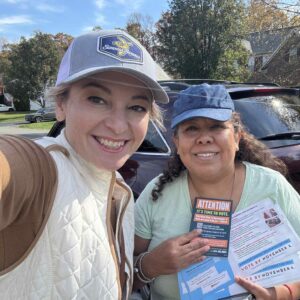
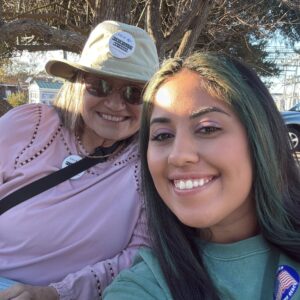
Meet the RRVA Organizing Team




Related Posts

Talking about the Constitutional Amendment for Reproductive Freedom
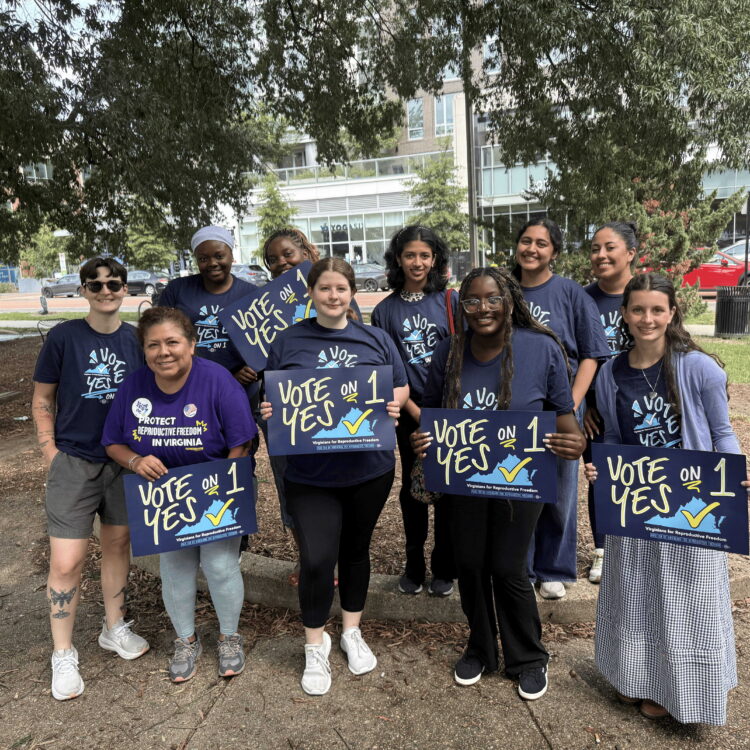
2026-2027 Student Advocacy Fellows Start the Year Off Strong
WATCH: YES on 1 Campaign Launches Six-Figure Digital Ad Campaign to Educate Virginia Voters on Reproductive Freedom Amendment